Galaxy Mergers
Galaxy Mergers in the Epoch of Reionization
This is my undergraduate project, supervised by Professor Christopher Conselice. In this project, we conducted the first comprehensive analysis of Galaxy Pair Fractions, Merger Rates, and Stellar Mass Accretion Rates at z > 6. [Paper Link]
We also investigated Merger-Triggered Star Formation Enhancements and AGN Activities at 4.5 < z < 8.5. [Paper Link]
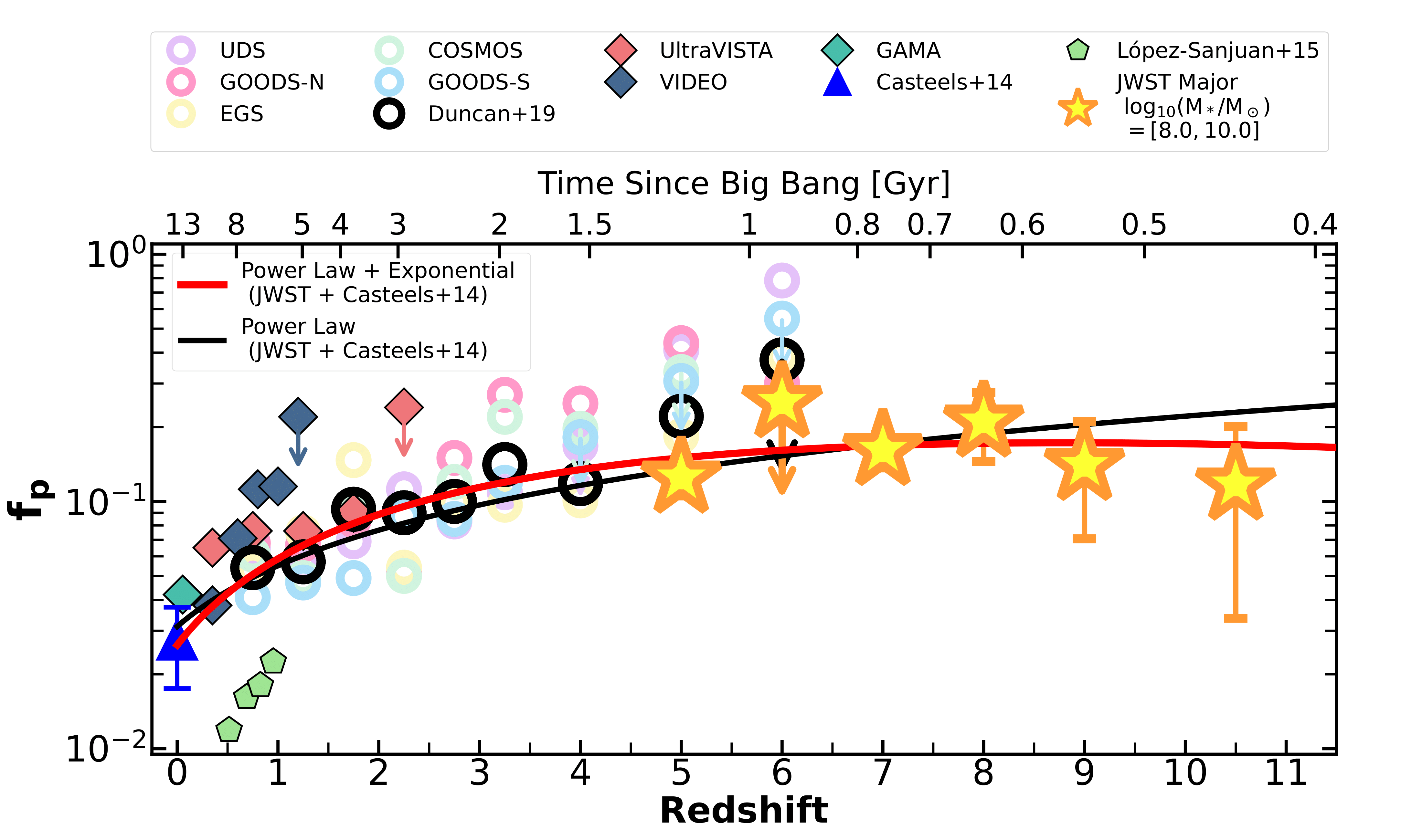
The figure below shows the evolution of galaxy pair fractions. These fractions are statistically computed using the full redshift and stellar mass posteriors of galaxies. Our new measurements are shown as yellow-orange stars. We observe a gradual increase in the major merger pair fraction up to $z \sim 8$, reaching a peak value of $0.211 \pm 0.065$. Overall, the evolution of pair fractions appears to remain flat for $z > 6$, with an average value of $0.17 \pm 0.05$.
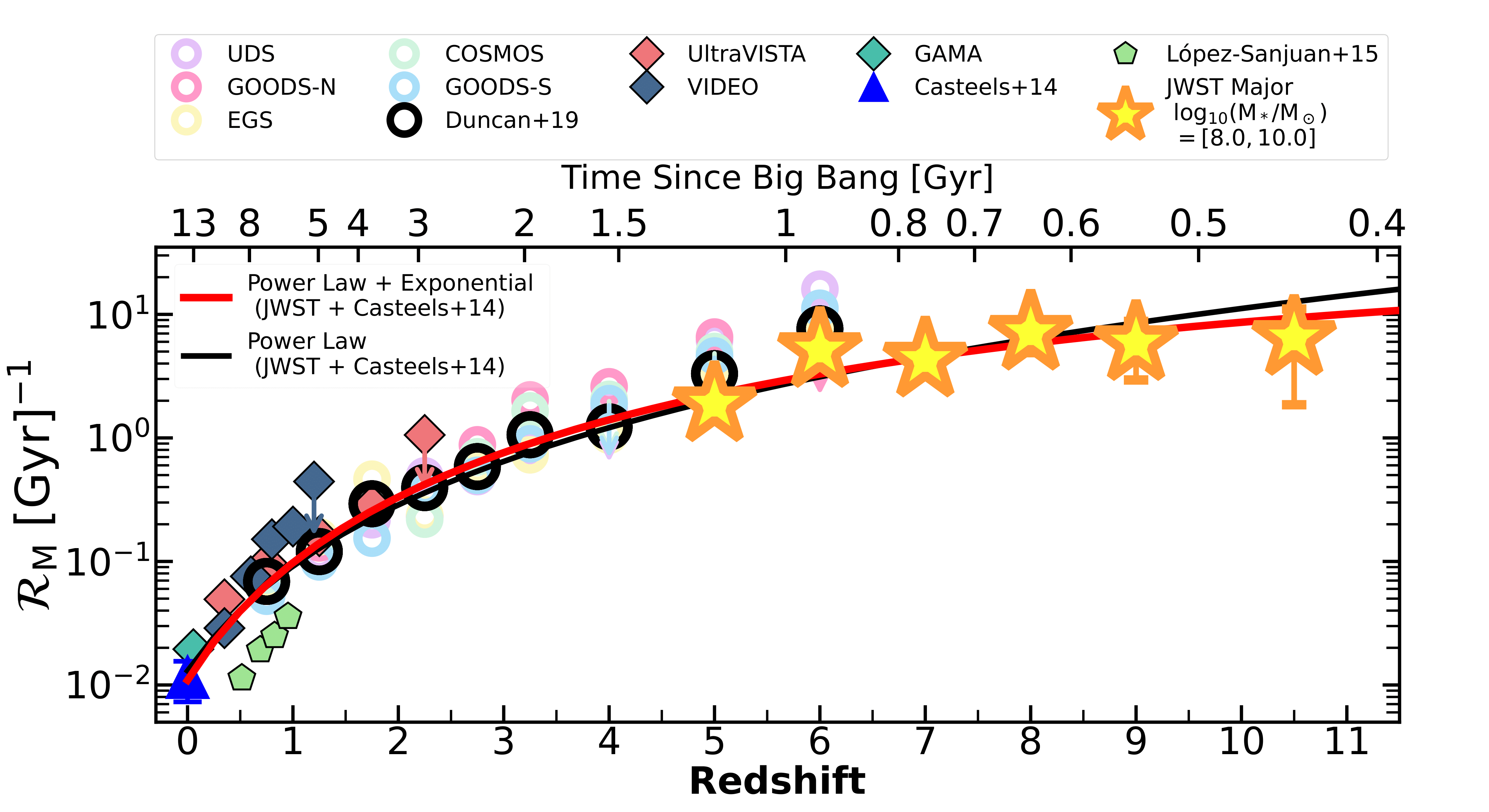
Based on the pair fractions above, we computed the Galaxy Merger Rates, defined as the number of mergers per galaxy per Gyr. The results are shown below ~ 🍀. In short, we observe a saturation in merger rates: the merger rate increases steadily between $z = 0.0$ and $z = 6.0$, and then stabilizes at higher redshifts. For $z > 6$, we find an average of $5.78 \pm 0.98$ merger events per galaxy per Gyr — an exceptionally rapid rate!! Further analysis indicates that galaxy mergers contribute to at least half of the total stellar mass assembly in the early Universe. 🥳
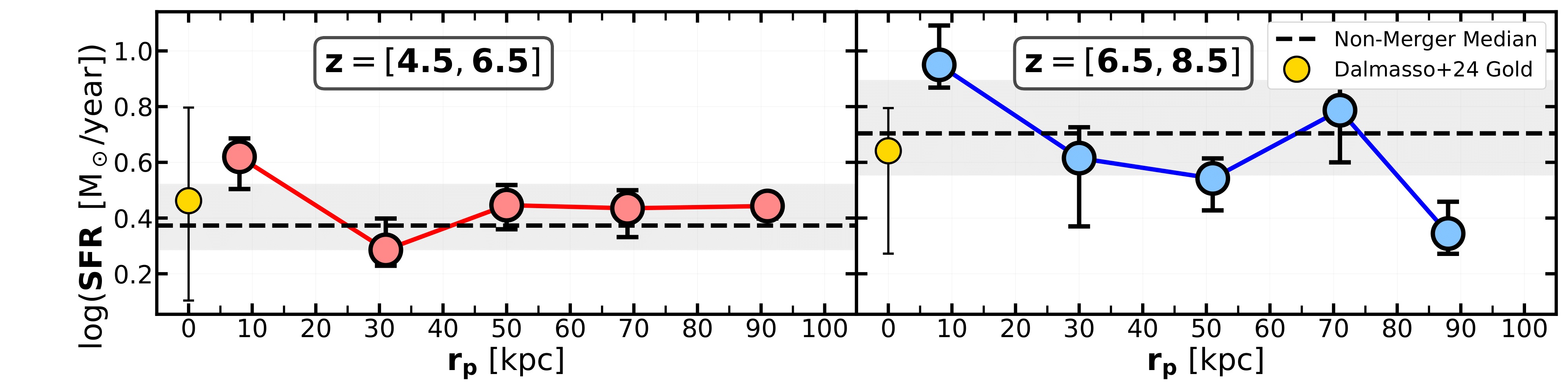
The Second Part of the Project focusing on Merger Triggered Star Formation Enhancements and AGN Activities. The following pictures show the degree of enhancements in close-pair samples, relative to non-merger samples. We find Enhancements in Star Formation rates:
- $z = [4.5, 6.5]$: $0.25 \pm 0.10$ dex above the non-merger Median, corresponding to $1.77 \pm 0.35$ (Solar-Mass/Year)
- $z = [6.5, 8.5]$: $0.26 \pm 0.11$ dex above the non-merger Median, corresponding to $1.76 \pm 0.49$ (Solar-Mass/Year)
Furthermore, we find that merger close-pairs are a significant factor in triggering AGN formation. By comparing the number of AGNs with close companions to those that are isolated, we define a term called AGN Excess. This excess is:
- Type-I (SED-Selected AGN): \(1.34^{+0.23}_{-0.11}\)
- Type-II (BPT-Selected AGN): \(1.26^{+0.15}_{-0.04}\)
Thank you for your time! Here are the links to the two papers again. Have a Nice Day~~~~