GSMF
Galaxy Stellar Mass Functions
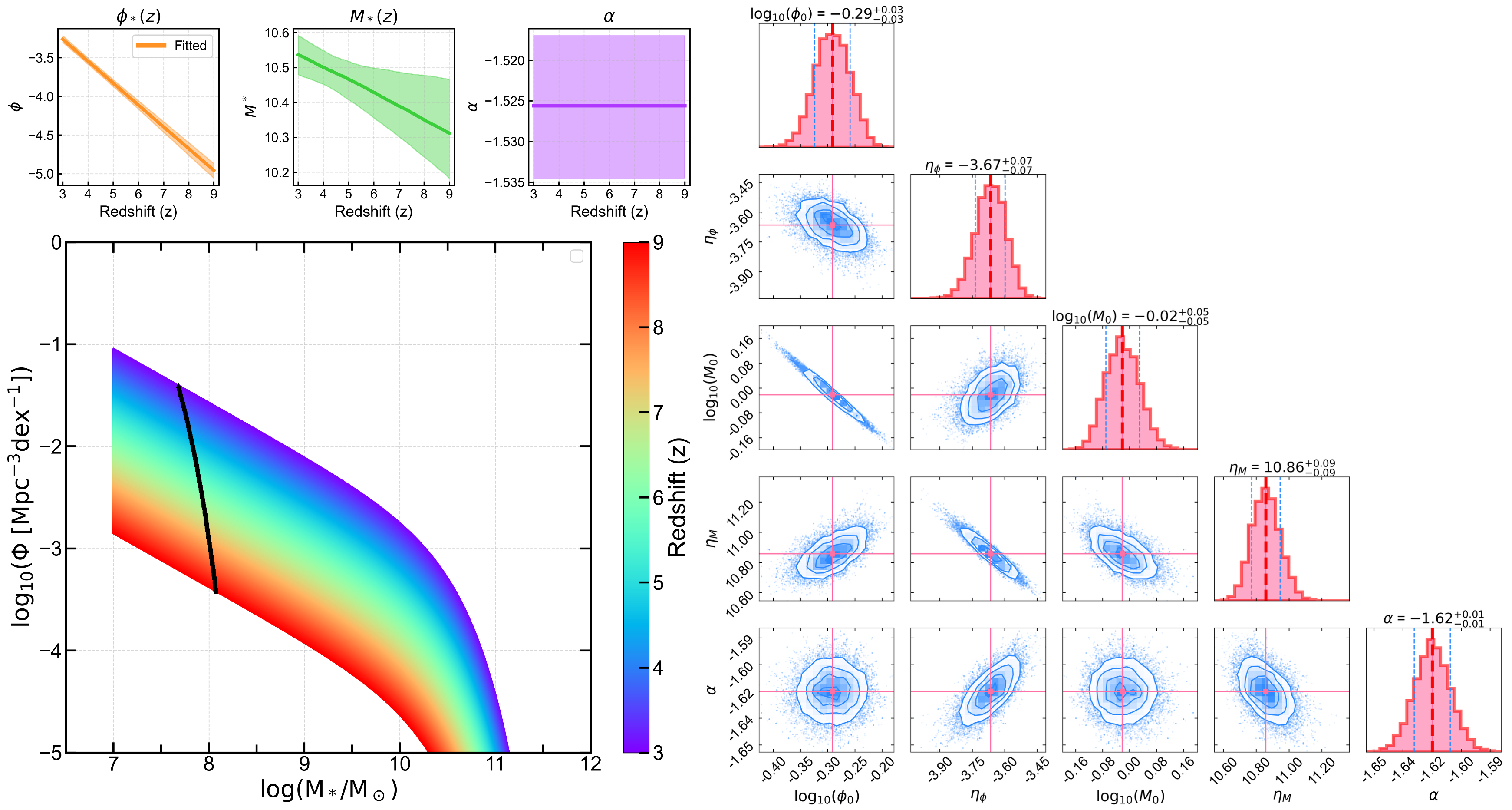
This is an intersting ongoing project! We are developing a forward-modeling bayesian method to fit galaxy stellar mass functions using all galaxies at once, incorporating their full redshift and stellar mass posteriors — all without any binning in redshift or stellar mass. This allows us to trace Evolving Stellar Mass Functions with unprecedented continuity and precision. More interestingly, the Schechter function parameters — \(\Phi^*\), \(M^*\), and \(\alpha\) — are now modeled as smooth functions of redshift: \(\mathbf{\Phi^*(z)}\), \(\mathbf{M^*(z)}\), and \(\mathbf{\alpha(z)}\). This means that parameter values across different epochs are no longer independent, but correlated through cosmic time!
Below we show our latest results 💫.
We use linear parameterizations to model the redshift evolution of our Schechter parameters as:
\[\boldsymbol{\theta}(z) = \boldsymbol{\theta}_0 + \boldsymbol{\theta}_{\eta} \, (z - z_\mathrm{ref}),\]where \(\boldsymbol{\theta}(z) \in \{\Phi^*(z), \mathcal{M}^*(z), \alpha(z)\}\).
The top-left plots show the redshift evolution of \(\Phi^*(z)\), \(\mathcal{M}^*(z)\), and \(\alpha(z)\). Schechter parameters’ evolution is fitted using nested sampling via Nautilus, with the corresponding corner plots shown on the right. The resulting evolving stellar mass functions (SMFs) are displayed on the left.